
Menu
.jpg)
Goods-to-person systems using robotic bin retrieval have operated in global distribution centers for years. Retailers, industrial distributors, and healthcare logistics providers have deployed grid-based storage systems to manage stock keeping unit (SKU) growth and direct-to-consumer volumes.
While robotics often receive the most attention, performance in automated warehouses depends heavily on how well the system integrates with warehouse management systems (WMS) and enterprise resource planning (ERP) platforms.
AutoStore deployments have always required tight integration to function in enterprise environments. A robotic grid cannot operate independently from order orchestration, inventory control, warehouse execution, and financial posting. The difference between successful and problematic implementations often comes down to how reliably those systems stay synchronized.
The Mechanics: Established, Structured, and Operationally Proven
Traditional warehouse layouts were designed around human reach. Shelving required aisles and travel time was built directly into the picking process. As order complexity increased and SKU counts expanded, walking distance became a structural limitation to fulfillment efficiency.
AutoStore’s architecture removes most internal aisles by stacking standardized bins vertically inside an aluminum grid. Battery-powered robots travel across the top of the grid, retrieve bins by lifting them from the stack, and deliver them to perimeter workstations. Operators pick items at ergonomically designed ports, after which the bins are returned to storage.
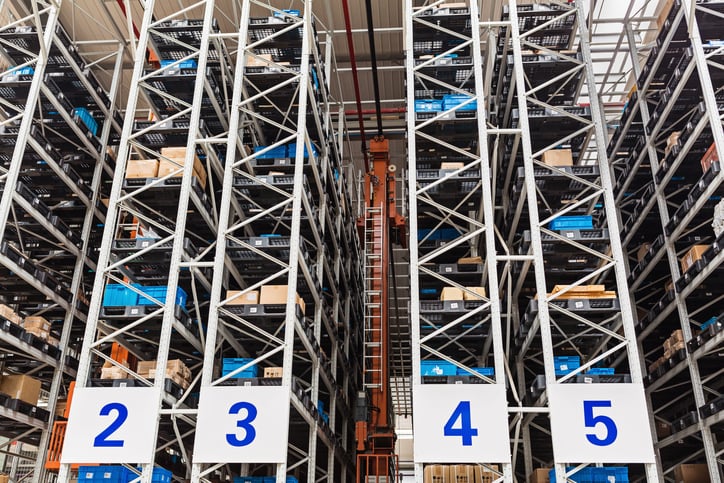
The system continuously reorganizes inventory positioning. Frequently requested items gradually migrate toward the top layers of the grid, reducing average retrieval time. This demand-driven bin positioning is managed algorithmically within the Autostore control software.
Today, AutoStore systems are deployed globally across retail, industrial distribution, healthcare, and e-commerce fulfillment centers. Integration partners such as Kardex, Bastian Solutions, and Norlift describe the system’s value in terms of storage density, modular expansion, and reduced operator travel.
Where Enterprise Value Is Determined: ERP and WMS Alignment
AutoStore does not operate independently from enterprise software systems. In SAP-driven warehouse environments, fulfillment execution originates in ERP and warehouse management platforms long before a robot retrieves a bin.
A typical Autostore architecture in an SAP landscape works as follows:
- A sales order is created in SAP S/4HANA or SAP ECC.
- A delivery document is generated.
- SAP WM or SAP Extended Warehouse Management (EWM) creates warehouse tasks.
- Those tasks are transmitted to the AutoStore control system through a certified integration layer.
- Robots retrieve the required bins and deliver them to picking ports.
- Operator confirmations are captured and sent back to SAP.
- Inventory quantities and goods issue postings are updated in ERP.
In practice, this process requires consistent communication between SAP WM or EWM and the AutoStore controller, including task confirmation, message retries, and execution activity logging for audit purposes. The integration layer ensures robotic execution remains aligned with inventory records.
Coordinating Physical Automation with Digital Control
AutoStore systems have been operating in global supply chains for years. What continues to mature is how warehouse automation integrates into enterprise technology ecosystems.
Warehouse automation today is less about replacing human effort and more about reorganizing workflows. Operators remain essential at workstations. ERP systems remain the authoritative source of inventory and financial records. Robotics primarily handles internal transport and bin retrieval within a tightly controlled framework.
When designed correctly, the automated warehouse becomes a coordinated environment where:
- ERP systems drive order orchestration.
- WMS translates business logic into execution tasks.
- Robotics performs structured inventory retrieval.
- Operational confirmations flow back to ERP systems in real time.
Fulfillment performance ultimately depends on both mechanical efficiency and data accuracy. Success is defined by synchronization across physical automation systems and digital software platform.
Robotic systems manage the physical movement of inventory, while ERP system integration ensures those movements are accurately reflected in warehouse operations and financial records.